
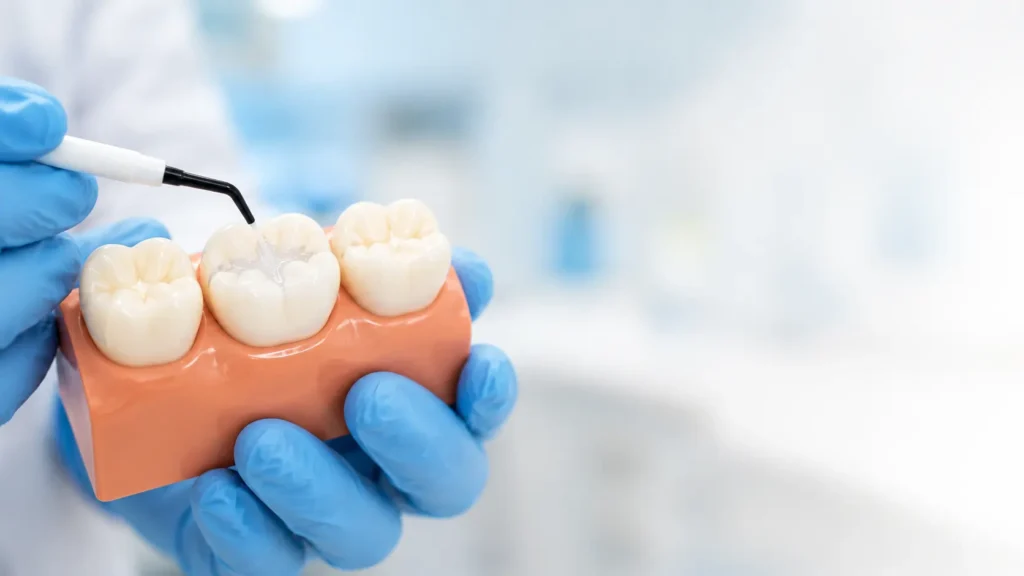

Types of Dental Sealants
There are different types of dental sealants. Your dentist will choose the best one based on your teeth and your risk of developing cavities.
Resin-Based Sealants
These are the most common types of dental sealant. They are strong, long-lasting, and help protect the chewing surfaces of back teeth from cavities.
Glass Ionomer Sealants
These sealants slowly release fluoride to help protect teeth. They may be recommended for patients who have a higher risk of tooth decay.
Your dentist will recommend the type of dental sealant that is best for your oral health.
How Long Do Dental Sealants Last?
A common question is how long do dental sealants last. With proper oral hygiene and regular dental checkups, many sealants remain effective for 5 to 10 years. During routine examinations, your dentist will check each sealant for signs of wear or damage and repair or replace it if necessary to maintain protection.
Dental Sealants for Cavities
Dental sealants for cavities are designed to help prevent new cavities rather than treat existing tooth decay. If a cavity is already present, your dentist will recommend the appropriate restorative treatment, such as a dental filling, before considering a sealant for other healthy teeth. Early examinations help identify the best preventive approach for each patient.
Sealants are most often placed on children’s back teeth. Dr. Katy Esfahanizadeh can check whether your child’s molars have come through far enough.
Using Dental Sealants for Sensitive Teeth
Some patients ask whether a dental sealant for sensitive teeth is appropriate. If tooth sensitivity is caused by exposed grooves or early enamel wear without decay, a sealant may provide additional protection in selected cases. However, sensitivity can have many causes, including cavities, gum recession, or cracked teeth. Your dentist will determine the underlying cause before recommending treatment.
Dental Sealant Procedure
1. Tooth Examination
The dentist or hygienist checks:
- Tooth eruption
- Groove depth
- Existing decay
- Previous fillings
- Cavity risk
- Ability to keep the tooth dry
Dental X-rays may be recommended when decay is suspected between teeth or beneath the surface.
2. Tooth Cleaning
The chewing surface is cleaned to remove plaque and debris.
3. Tooth Preparation
A conditioning material is placed on the enamel for a short period. This prepares the surface so the sealant can bond properly.
4. Sealant Placement
The tooth is rinsed and dried. Sealant material is applied into the grooves.
5. Curing and Bite Check
The material is hardened, usually using a curing light. The dental team checks that the sealant is secure and does not interfere with the bite.
The procedure usually does not require drilling or local anaesthetic when the tooth has no cavity.
Do Dental Sealants Hurt?
Sealant placement is generally comfortable because the treatment is applied to the outer enamel surface.
Patients may notice:
- Air or water during cleaning
- A temporary taste from dental materials
- A slightly different feeling when biting
- A thin coating over the tooth grooves
A sealant that feels noticeably high or uncomfortable should be checked and adjusted.
Sealants for Children
Children may benefit when permanent molars erupt and the grooves are difficult to clean.
The dentist will consider:
- Tooth eruption
- Previous cavities
- Brushing ability
- Diet
- Fluoride exposure
- Groove depth
- Overall cavity risk
Sealants do not replace supervised brushing, fluoride toothpaste, flossing or dental examinations.
Can Adults Get Dental Sealants?
Selected adults may receive sealants when they have deep, healthy and unrestored grooves that remain vulnerable to decay.
Sealants may be less suitable when an adult tooth has:
- An existing filling
- A visible cavity
- Significant enamel breakdown
- A restoration covering the groove
- A surface that cannot be kept dry
- Decay that requires a filling
The decision should be based on examination rather than age alone.
Dental Sealants Versus Fluoride
Sealants and fluoride treatments protect teeth in different ways.
Dental Sealants
Sealants form a physical barrier over selected pits and grooves.
Fluoride Treatment
Fluoride helps strengthen enamel and supports remineralization across treated tooth surfaces.
Patients at increased cavity risk may benefit from both treatments as part of a preventive plan.
Dental Sealants Versus Fillings
Sealants are preventive. They are generally placed on suitable tooth surfaces before a large cavity develops.
A dental filling repairs tooth structure that has already been damaged by decay or fracture.
A sealant cannot rebuild a formed hole in a tooth. Cavitated decay generally requires restorative treatment.
What Is a Preventive Resin Restoration?
A preventive resin restoration combines limited removal of a small suspicious or decayed area with resin material and sealant coverage.
It may be considered when:
- A groove contains localized early decay
- The rest of the chewing surface can be protected
- A full conventional filling is not required
It is different from placing a sealant on an intact tooth.
Limitations of Dental Sealants
Dental sealants:
- Protect only the surfaces they cover
- Do not protect between teeth
- Do not replace fluoride toothpaste
- Do not replace flossing
- Cannot repair a large cavity
- May chip or wear
- Can partially detach
- Require examination at future visits
- May need repair or replacement
- Do not last indefinitely
Decay can still develop around or beneath a damaged sealant, particularly when follow-up care is missed.
How Long Do Dental Sealants Last?
There is no guaranteed lifespan.
Sealant longevity depends on:
- Tooth location
- Material
- Bite forces
- Grinding or clenching
- Moisture control during placement
- Oral hygiene
- Diet
- Regular dental assessment
The dental team should check sealants during routine examinations and repair or replace them when clinically appropriate.
Caring for Sealed Teeth
After sealant placement:
- Brush twice daily with fluoride toothpaste
- Clean between teeth every day
- Limit frequent sugary snacks and drinks
- Avoid chewing ice and hard objects
- Attend dental examinations
- Report a rough or missing sealant
- Continue professional cleanings as recommended
No special toothpaste is normally required solely because a tooth has been sealed.
Dental Sealant Cost in Vaughan
The cost depends on:
- Number of teeth treated
- Primary or permanent teeth
- Sealant or preventive resin restoration
- Examination requirements
- Dental X-rays when needed
- Private insurance
- CDCP eligibility
My City Dental can provide an estimate after examining the teeth and confirming which surfaces are suitable.
Do not publish a fixed sealant price unless the clinic confirms its current fees and exactly what is included.
Does Dental Insurance Cover Sealants?
Many private dental plans provide some sealant coverage, particularly for children and teenagers.
Coverage may depend on:
- Patient age
- Eligible tooth type
- Tooth surface
- Previous restorations
- Frequency limits
- Lifetime limits per tooth
- Annual maximum
- Plan-specific rules
Direct insurance billing does not guarantee complete reimbursement.
Does CDCP Cover Dental Sealants?
Under the current Canadian Dental Care Plan, eligible patients aged 17 and under may receive sealants or preventive resin restorations on certain unrestored permanent tooth surfaces.
Eligible surfaces can include:
- Chewing surfaces of permanent molars
- Chewing surfaces of permanent premolars
- Lingual surfaces of permanent upper incisors
Third molars, permanent canines and lower incisors are not eligible. The current guide also sets a lifetime limit of two sealants or preventive resin restorations per eligible tooth.
Patients may still need to pay:
- An income-based co-payment
- A difference between clinic and CDCP fees
- Treatment beyond program limits
- Services or teeth that are not eligible
Visit the My City Dental CDCP information page for broader program information.
Frequently Asked Questions About Dental Sealants
Are dental sealants only for children?
No. They are most commonly placed on children’s newly erupted permanent teeth, but selected teenagers and adults may also benefit.
Can sealants be placed over cavities?
A sealant should not simply cover a large untreated cavity. Small suspicious areas may require a preventive resin restoration or filling.
Do sealants require drilling?
Standard sealant placement normally does not require drilling. Limited tooth preparation may be needed for a preventive resin restoration.
Can dental sealants fall out?
Sealants can wear, chip or partially detach. They should be checked during dental examinations.
Can you brush sealed teeth normally?
Yes. Continue brushing twice daily with fluoride toothpaste and cleaning between the teeth.
Do sealants protect between teeth?
No. Sealants mainly protect pits and grooves on the surface where they are placed.
Are sealants the same as fillings?
No. Sealants help prevent decay on suitable surfaces. Fillings repair tooth structure already damaged by decay or fracture.
Can adults receive CDCP coverage for sealants?
Current routine CDCP sealant coverage is limited to eligible patients aged 17 and under.
Do dental sealants contain BPA?
Some resin-based dental materials can contain or produce extremely small amounts of BPA-related compounds. The Canadian Dental Association states that exposure from dental sealants is extremely small and limited to certain products.
Book a Dental Sealant Assessment in Vaughan
Concerned about deep tooth grooves or cavities in your child’s back teeth?
Schedule a preventive assessment at My City Dental. The dental team will examine the teeth and explain whether sealants, fluoride or another preventive treatment may be appropriate.